







Vaccination — Jenner
Cowpox inoculation against smallpox — a method that works a century before anyone can explain why, and ends in the only human disease ever eradicated, certified in 1980.
For most of recorded history a newborn could expect about thirty years. The figure barely moved for millennia — it was still near thirty in 1870. Then, in six generations, it more than doubled: anatomy, then contagion, then the cell, then the code, then the machine.
The Edwin Smith Papyrus works through forty-eight injuries in strict order, skull downward. Each case gets an examination, a diagnosis, and a verdict: an ailment I will treat, an ailment I will contend with, an ailment not to be treated. Almost no magic appears anywhere in it. This is a surgeon writing down what he saw.
~30est. at birth
The Hippocratic writers — some sixty texts by many hands — make one decisive move. On the Sacred Disease argues that epilepsy is no more divine than any other illness; it has a cause in the body. Unable to cure much, they build something more durable instead: prognosis. Watch the patient, record the course, learn what comes next.
~30est. at birth
Vesalius, twenty-eight, does his own dissections rather than reading Galen aloud while a barber cuts. Galen had dissected animals, so his sternum has seven segments and his heart has pores between the chambers — pores Vesalius could not find. De Humani Corporis Fabrica pairs the corrections with engraving, and anatomy becomes something you can study without opening a body.
~30est. at birth
Semmelweis finds that washing hands in chlorinated lime collapses deaths in a Vienna maternity ward, and is disbelieved. Snow maps cholera deaths onto one Broad Street pump and has its handle removed. Pasteur supplies the mechanism; Lister acts on it, publishing antiseptic surgery in 1867. Medicine stops fighting bad air and starts fighting organisms.
~30global, 1870
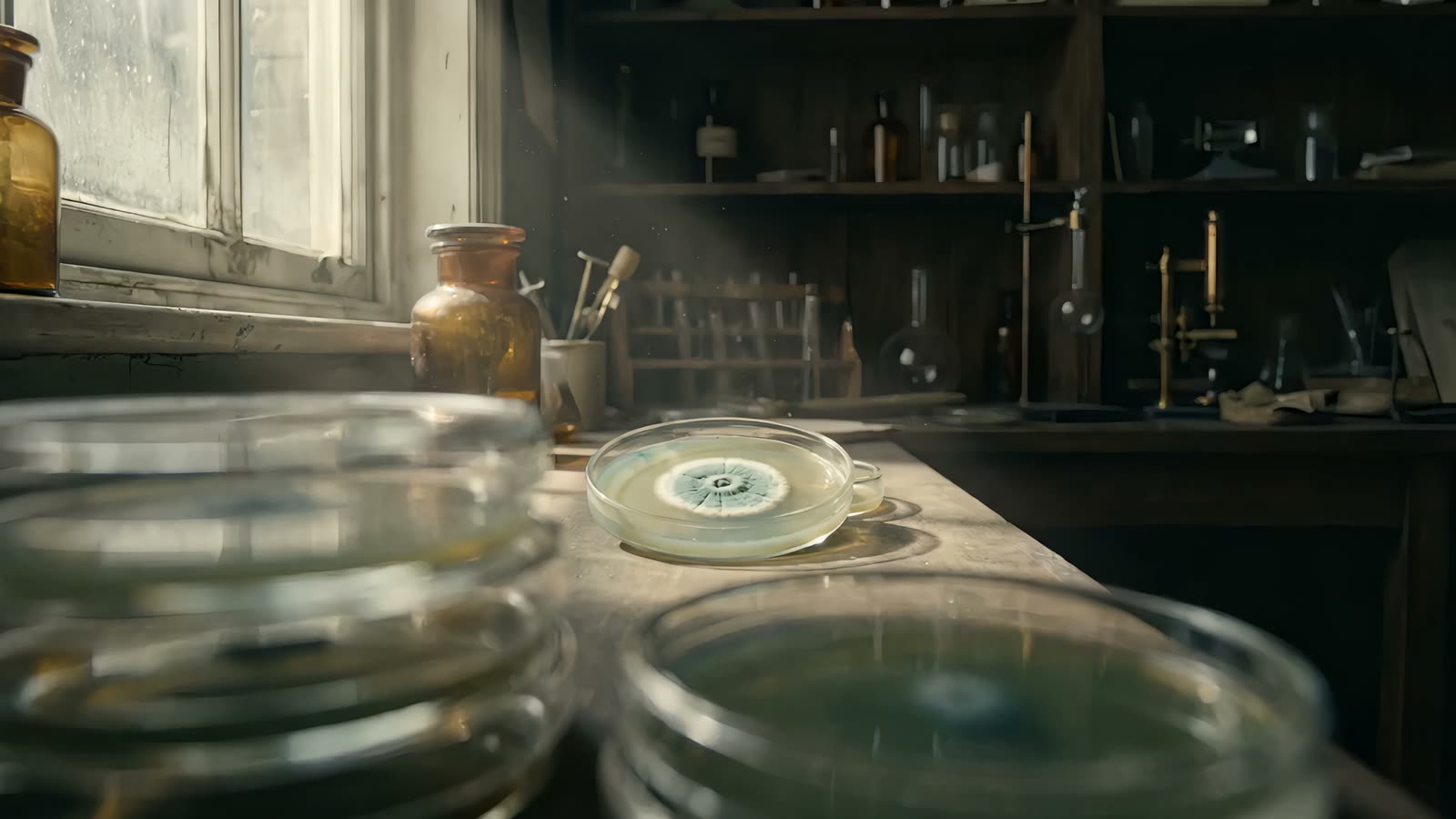
Fleming notices a contaminated plate where Penicillium has cleared a ring through the staphylococci — then cannot make enough of it to matter. A decade later Florey, Chain and Heatley at Oxford turn the observation into a manufacturable drug, in time for the war. A scratch, a birth, a chest infection each stop being plausible ways to die.
~35global, 1930
Photograph 51 — an X-ray diffraction image made in Rosalind Franklin's laboratory by her student Raymond Gosling — carries the geometry. Watson and Crick, shown it without her knowledge, publish the model in Nature that April. The body turns out to run on a legible four-letter text, copied into every cell, and copied imperfectly over time.
~47global, 1950
Thirteen years and roughly three billion base pairs later, the Human Genome Project declares the sequence essentially complete — about ninety-two per cent of it. The remaining gaps were not closed until 2022. The first genome cost billions; within two decades, reading one costs less than a night in hospital.
~67global, 2000
Barnard transplants a human heart in 1967. Imaging makes diagnosis non-invasive, intensive care holds people through what used to kill them, and in 2000 the da Vinci system is cleared for general surgery — a surgeon now operating through four small ports from a console across the room. Medicine becomes extraordinarily good at repair: valves, joints, kidneys, corneas, arteries. The number keeps climbing.
~71global, 2010
Repair extends life without always extending health. Global life expectancy is 73.2 years; healthy life expectancy is closer to 63 — roughly a decade spent in decline. So ageing itself is now treated as a process with mechanisms: senescent cells, epigenetic drift, mitochondrial decline. Biological-age clocks give it a readout. The question stops being how long we last, and becomes how long we last well.
73.2global, 2023
Life expectancy at birth is a blunt instrument — it is dragged down hardest by children who die early, which is exactly why it moved so violently once infection was understood. Note where the line still sits in 1870, two decades after Semmelweis: the discoveries land well before the number answers.
years added to the global average since 1800 — from 28.5 to 73.2, more than doubling it. Almost all of that arrives after 1900.
The frontier has moved. Healthy life expectancy sits near 63, so the average person now spends around a decade alive but in decline. Closing that gap is a different problem from extending the line.
Global life expectancy at birth · Our World in Data, UN World Population Prospects. Healthy life expectancy · WHO. Figures rounded; pre-1800 values are estimates.Not the most famous discoveries — the most consequential ones. Each removed a common way of dying before old age.
Cowpox inoculation against smallpox — a method that works a century before anyone can explain why, and ends in the only human disease ever eradicated, certified in 1980.
Morton demonstrates ether at Massachusetts General. Surgery stops being limited by how fast a surgeon can cut and how much a conscious patient can bear.
A dot map of cholera deaths around one pump. Sanitation and sewerage go on to save more lives than any drug ever synthesised.
The living interior becomes visible without a scalpel. Diagnosis separates from dissection, and imaging becomes a discipline of its own.
Type 1 diabetes converts from a death sentence measured in months to a managed condition measured in decades. The first patient is treated in January 1922.
Immunisation at national scale, and proof that a coordinated public-health campaign can retire a disease from ordinary life.
Cape Town. The patient lives eighteen days, but the principle holds: a failed organ can be replaced rather than merely managed.
Cardiovascular disease, the leading cause of death in the developed world, becomes partly preventable in people who feel entirely well.
Cleared for general laparoscopic surgery. The surgeon moves to a console; the incision shrinks to a few ports; recovery time collapses.
Methylation patterns predict biological age more accurately than the calendar. Ageing acquires a measurable readout — and anything measurable can be targeted.
Everything before this point was done for you by other people. This part is not. The six pillars below are the levers with the best evidence behind them — and their real prize is not a longer bar. It is a longer healthy bar, with the decline at the end squeezed into a shorter span. Switch them on.
Healthspan — lived in good health The decline — alive, but not well
Baseline is the global average: 73.2 years of life, about 63 of them in good health. The all-pillars figure is anchored to Li et al. 2018 (Circulation), which found roughly twelve additional years of life expectancy at age 50 for people holding several low-risk lifestyle factors at once. That combined effect is then distributed across the six pillars by relative weight. Real effects overlap and interact — they do not simply add — so treat the per-pillar movement as illustrative of direction and rough magnitude, not as a personal forecast.
None of it is exotic. The hard part is not knowing what the levers are — it is knowing which ones matter most for you, and what the evidence actually says once you look past the headline. That is what the Journal is for: a physician reading the research so you don't have to.
Read the JournalOr start with the podcast, the latest research news, or who is behind this.